
Key takeaways
- A plate heat exchanger stands wherever two cooling loops meet, from the rack to the cooling tower.
- CDU heat exchangers keep the clean chip coolant separate from facility water.
- A close temperature approach at the economiser means more hours of free cooling each year.
- Stainless steel 316 plates with EPDM gaskets cover most data centre water and glycol loops.
- Heat at 50 to 80 °C can be exported to district heating through a plate heat exchanger.
Why do data centres use plate heat exchangers?
Every kilowatt of IT power becomes a kilowatt of heat that has to leave the building. On its way out, that heat passes through several water loops, and each loop has to stay separate: clean coolant for the chips, treated facility water, and open tower water or glycol outdoors.
A plate heat exchanger is the compact way to pass heat between two loops without mixing them. It brings the two temperatures very close together, which is what liquid cooling and free cooling both depend on.
The ARES PHE data centre solutions page gives the overview. This guide goes position by position.
Loops that never mix
Chip coolant, facility water and tower water each stay in their own circuit.
Close temperature approach
The two loops are brought within a few degrees of each other, so less chiller work is needed.
Capacity that can be added
Plates can be added to a gasketed unit, and units run in parallel as the IT load grows.
How does the heat leave a data centre?
Heat moves outward through a chain of loops. The numbers mark where a plate heat exchanger stands.
Which heat exchangers serve liquid cooling?
Liquid cooling brings coolant to the chip, and the coolant distribution unit (CDU) is where that coolant gives its heat to facility water. Facility-scale CDU heat exchangers are installed in parallel for plants from 1 to 10 MW, while row CDUs typically handle 1 to 2.5 MW each.
| Position | ARES PHE fit | Plates | Gaskets |
|---|---|---|---|
| Facility-scale or row CDU heat exchanger | A-Series, or AP-Series for a close approach | 316 | EPDM |
| In-rack or in-row CDU heat exchanger | ABR brazed, or A-Series | 316 | None (brazed) |
| Immersion CDU, dielectric fluid to water | A-Series, or ABR brazed | 316 | To be confirmed against the fluid |
| Two-phase direct-to-chip, refrigerant-to-water condenser | ABR brazed, or ASW semi-welded | 316 | None in the refrigerant |
| Two-phase immersion, tank-water loop separation | A-Series, or ABR brazed | 316 | EPDM |
For the gasketed positions, the ARES A-Series is the standard choice and the AP-Series takes over where the two loops must come within about 3 °C of each other. Inside the rack or row, where space is tight, the ABR brazed series fits.
Which heat exchangers serve facility water and free cooling?
When the outdoor loop is colder than the facility water, the chillers can be bypassed and the heat goes through a plate heat exchanger to the cooling tower or dry cooler. The same exchanger keeps open tower water, with its dissolved solids and treatment chemicals, out of the clean facility loop.
| Position | ARES PHE fit | Plates | Gaskets |
|---|---|---|---|
| Waterside economiser (free cooling) | A-Series, or AP-Series for a close approach | 316 | EPDM |
| Cooling-tower isolation heat exchanger | A-Series | 316 | EPDM |
| Dry-cooler glycol loop breaker | A-Series, or ABR brazed | 316 | EPDM |
| Facility-water to heat-rejection interface | A-Series, or AP-Series | 316 | EPDM |
Tower water concentrates chlorides as it evaporates. Check the analysis against the plate temperature before fixing the plate grade; the material selection guide gives the limits.
Which heat exchangers serve heat reuse?
More operators now export their heat instead of releasing it. Heat at 50 to 80 °C can go to a district heating network directly, or a heat pump can lift cooler facility water to that level first. Either way, a plate heat exchanger separates the data centre from the network.
| Position | ARES PHE fit | Plates | Gaskets |
|---|---|---|---|
| Heat-recovery interface, facility water to district heating | A-Series, or AP-Series | 316 | EPDM |
| Heat-pump evaporator on data-centre water | ABR brazed, or ASW semi-welded | 316 | None in the refrigerant |
| Heat-pump condenser on the district-heating side | ABR brazed, or ASW semi-welded | 316 | None in the refrigerant |
| Heat-pump subcooler or oil cooler | ABR brazed, or A-Series | 316 | By oil type |
Planning a liquid-cooled or free-cooled plant?Send your loads, flows and temperatures and ARES PHE engineering will propose the exchanger for each position.
Contact our engineersWhat should you look for in a data centre heat exchanger?
- Approach temperature: how close the two loops must come
- Redundancy: units in parallel so one can be serviced
- Growth: room in the frame for more plates
- Coolant compatibility: gasket confirmed for the fluid
- Water quality: chlorides and solids in tower water
- Footprint: plant-room and rack space available
These tables show the usual fit for each position. The final unit is always sized for the actual load, flows and temperatures in the ARES PHE design software, and brazed and welded selections are confirmed with ARES PHE engineering.
Why ARES PHE
ARES PHE has manufactured plate heat exchangers in Adana, Türkiye since 2002 and exports 95% of its production. Plates are pressed in-house, with a pressing capacity of up to 20,000 tons.
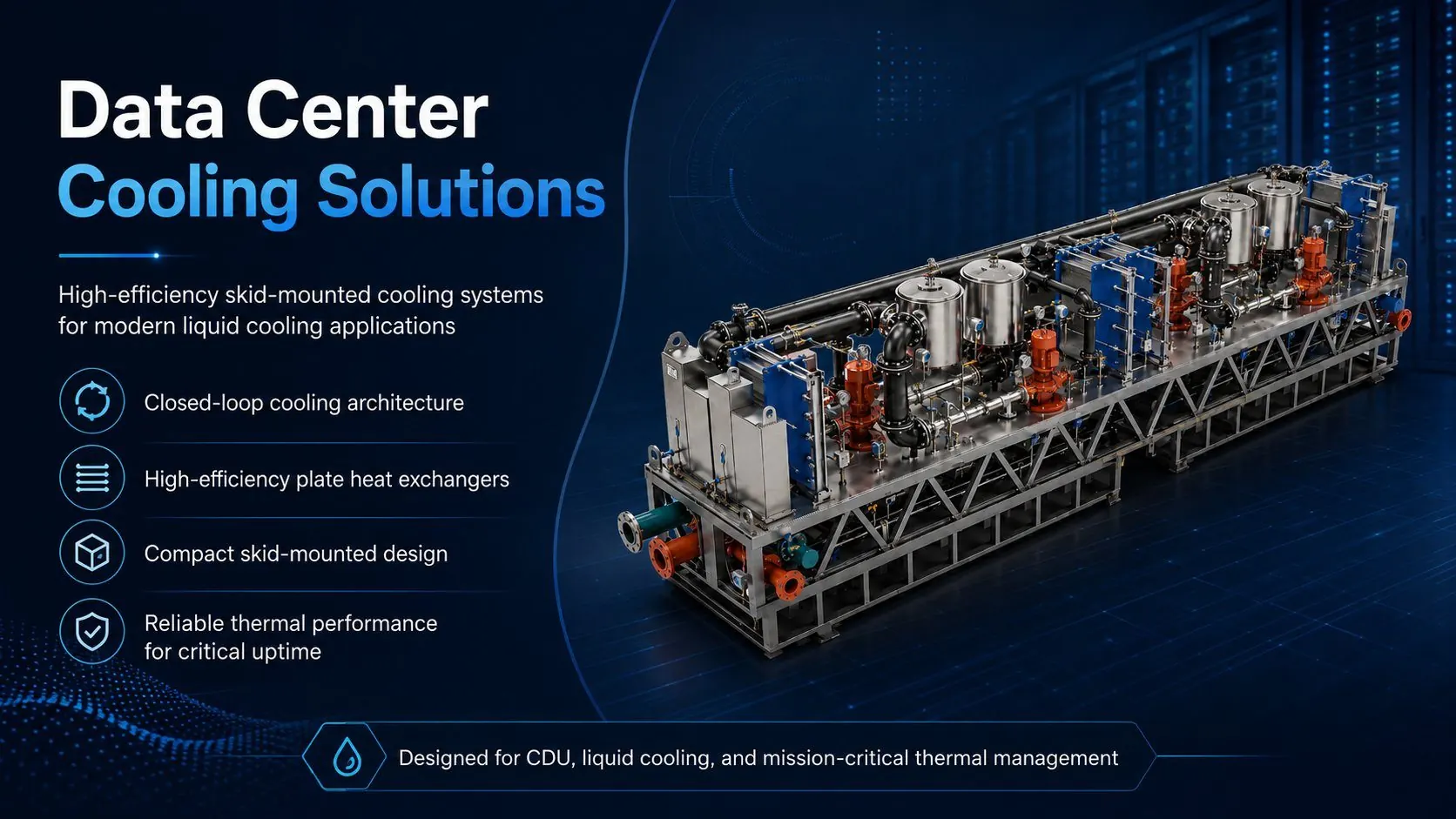
One supplier covers every position in this guide: gasketed A-Series and AP-Series units for CDU, free-cooling and heat-reuse duties, ABR brazed units for the rack and row, and ASW semi-welded units for refrigerant duties. Units can be supplied skid-mounted for plant-room installation.
ARES PHE engineers work from your load, flow and temperature data, and plates can be added later as the IT load grows.
Frequently asked questions
Where are plate heat exchangers used in a data centre?
At every point where two liquid loops meet. The main positions are the coolant distribution unit for liquid-cooled racks, the waterside economiser for free cooling, the isolation exchanger between cooling tower and facility water, the dry-cooler glycol loop breaker and the connection that exports heat to district heating.
What does the plate heat exchanger do in a CDU?
It separates the clean coolant loop that serves the chips from the facility water loop, and passes the heat from one to the other. Facility-scale and row units typically use gasketed exchangers. In-rack and in-row units often use compact brazed exchangers.
Which plate and gasket materials are used for data centre duties?
Stainless steel 316 plates with EPDM gaskets are the usual selection for treated water and glycol loops. For single-phase immersion systems, the gasket has to be confirmed against the dielectric fluid. Open cooling-tower water should be checked for chlorides before the plate grade is fixed.
Why does a close temperature approach matter for free cooling?
Free cooling works whenever the outdoor loop is colder than the facility water it has to cool. The closer the exchanger brings the two temperatures together, the more hours of the year the chillers can stay off. That is the duty the ARES AP-Series is built for.
Can data centre heat be reused for district heating?
Yes. Heat at 50 to 80 °C can be exported to a district heating network through a plate heat exchanger, either directly or after a heat pump has raised its temperature. The exchanger keeps the data centre water and the network water in separate loops.