
Data Centres
Every kilowatt of IT power eventually becomes a kilowatt of heat that must leave the building. Plate heat exchangers sit at the critical junctions of data centre cooling: between chiller plant and cooling tower, between free-cooling loop and white space chilled water, and increasingly between direct-to-chip liquid cooling and facility water. As PUE expectations tighten and high-density compute drives liquid cooling adoption, the PHE is more strategic than ever.
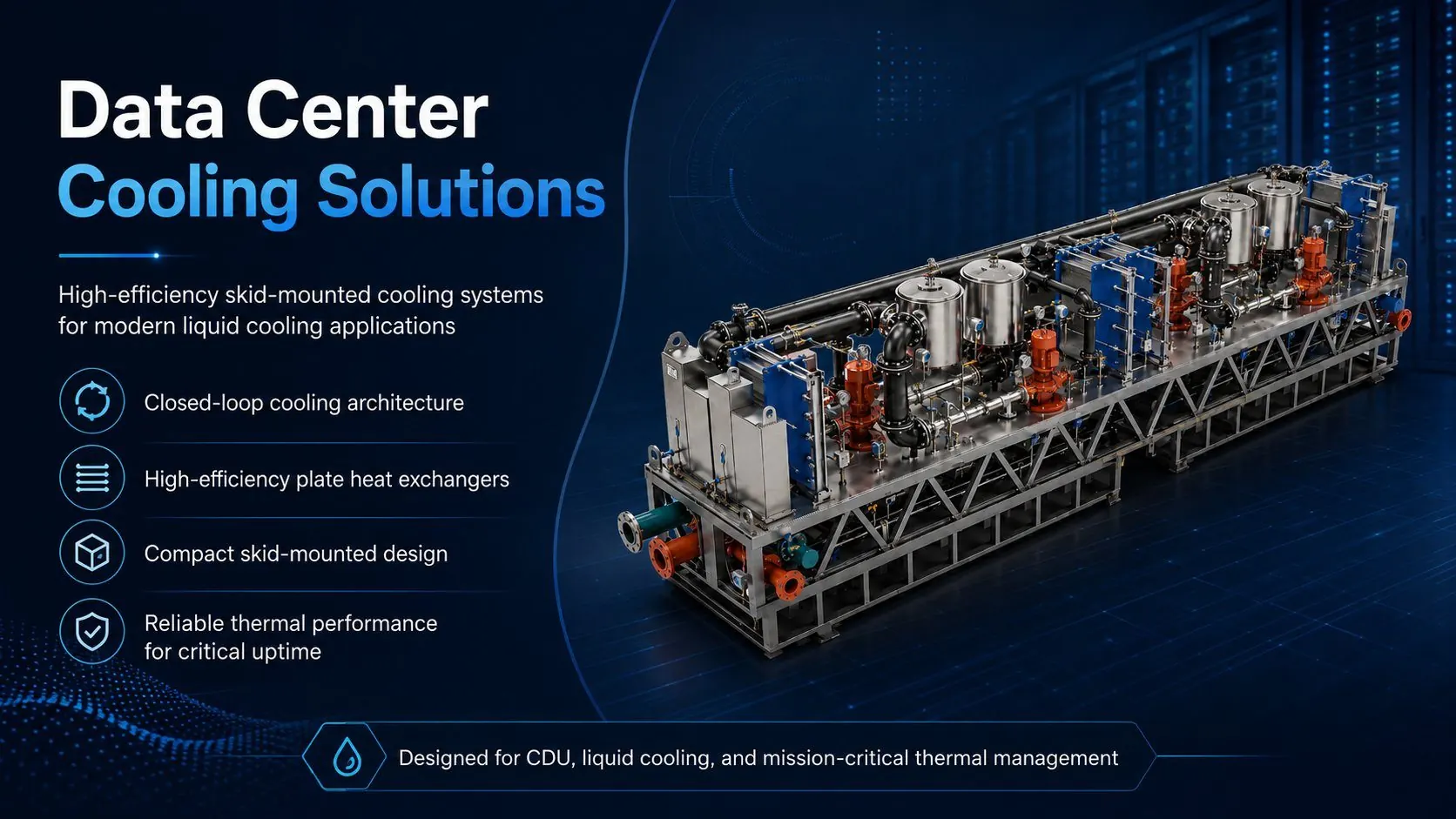
Where PHEs Work in Data Centres
From the rooftop economiser to the rack-side cooling distribution unit, plate heat exchangers handle every thermal junction in modern data centre cooling architectures.
Free Cooling Economiser, The PUE Lever
When outdoor wet-bulb temperatures fall far enough below the chilled water supply temperature (allowing for tower and PHE approach), typical in many regions for a large part of the year, the chiller can be bypassed and the cooling tower can directly supply chilled water through a plate heat exchanger. This is one of the largest PUE improvements available, often saving 30-50% on annual cooling energy.
Free-cooling PHE sizing is critical: the exchange operates at small temperature difference (ΔT), often with marginal driving temperature, demanding very high thermal effectiveness. Plate selection, pass arrangement, and channel count must all be tuned for low-ΔT performance. ARES PHE supplies free-cooling units engineered for low-ΔT performance that match design model expectations.
Chiller-Side Heat Rejection
Many water-cooled chiller plants reject condenser heat to cooling towers through a PHE that isolates the closed condenser water loop from the open tower water (full of dissolved solids, biocides, and corrosion inhibitors).
Without the PHE, tower water would foul and scale up condenser tubes within a year.
Direct-to-Chip Liquid Cooling
High-density compute (AI training clusters, HPC workloads) now demands liquid cooling at the chip level. The cooling distribution unit (CDU) inside the rack circulates clean dielectric fluid or treated water through cold plates on each CPU/GPU. The CDU rejects heat to the facility water loop through a plate heat exchanger.
PHEs in CDU duty operate at very tight ΔT, demand chemical compatibility with engineered coolants, and must meet reliability targets matching the IT equipment they protect.
Immersion Cooling
Immersion cooling submerges IT hardware in dielectric fluid; the fluid vapour (or warm liquid) rejects heat through a condenser-style PHE to facility water. Single-phase and two-phase systems each have specific PHE design requirements.
Material compatibility with engineered dielectric fluids drives plate and gasket selection.
White Space Distribution
Building-side chilled water at facility temperature (typically 18-25°C) is distributed via the white space mechanical infrastructure to CRAH units, in-row coolers, and rear-door heat exchangers. PHEs handle the building-side hydraulics at the boundary.
Pressure separation between building risers and white space distribution is often required.
Heat Recovery & District Energy
Increasingly, data centre operators capture waste heat and export it to district heating networks, greenhouses, or adjacent industrial users. The reject-water side of the cooling tower becomes a heat source for an adjacent heating demand.
PHEs handle the interface between the data centre's high-volume, low-grade heat and the heat-consumer's higher-temperature requirement.
UPS & Mechanical Equipment Cooling
Large UPS systems, transformers, switchgear rooms, and ancillary mechanical equipment all need cooling. PHEs handle the closed-loop cooling water side for these ancillary loads.
Compact A-Series units fit easily into electrical room layouts.
Why PHEs Are Standard in Data Centres
PUE Optimisation
Free-cooling exchange is the single biggest energy-efficiency lever
Liquid Cooling Ready
Direct-to-chip and immersion CDU interfaces handled in standard products
Uptime Compatible
Dual-bank (N+1) installations support 99.99%+ uptime targets
Heat Recovery Ready
Capture data centre waste heat for district energy export and ESG reporting
Compact Footprint
Mechanical room floor area is rented at premium rates
Recommended Products for Data Centres
AP-Series (Performance)
Free cooling, chiller-side, white space distribution
A-Series (Gasketed)
UPS cooling, ancillary loads, building-side hydraulics
AWG Free Flow
Open cooling tower water with elevated TSS
Case Studies
Real projects, real results. See how ARES PHE plate heat exchangers perform in Data Centre Liquid Cooling installations worldwide.
Data Centre Liquid Cooling Case Study
Project overview, engineering approach, and measured results from a real installation.
Read Case Study →Engineer Your Data Centre Cooling With Us
Whether you're designing a hyperscale economiser loop, integrating liquid cooling for AI compute, or planning waste heat export to district energy, our data centre application engineers work with your design team from concept through commissioning.