Spiral Heat Exchangers
Spiral heat exchangers for viscous liquids, sludges, slurries, and fluids carrying fibres or particles. Available in removable-cover and fully welded configurations for heating, cooling, and heat recovery duties.
Built for the fluids that defeat other designs
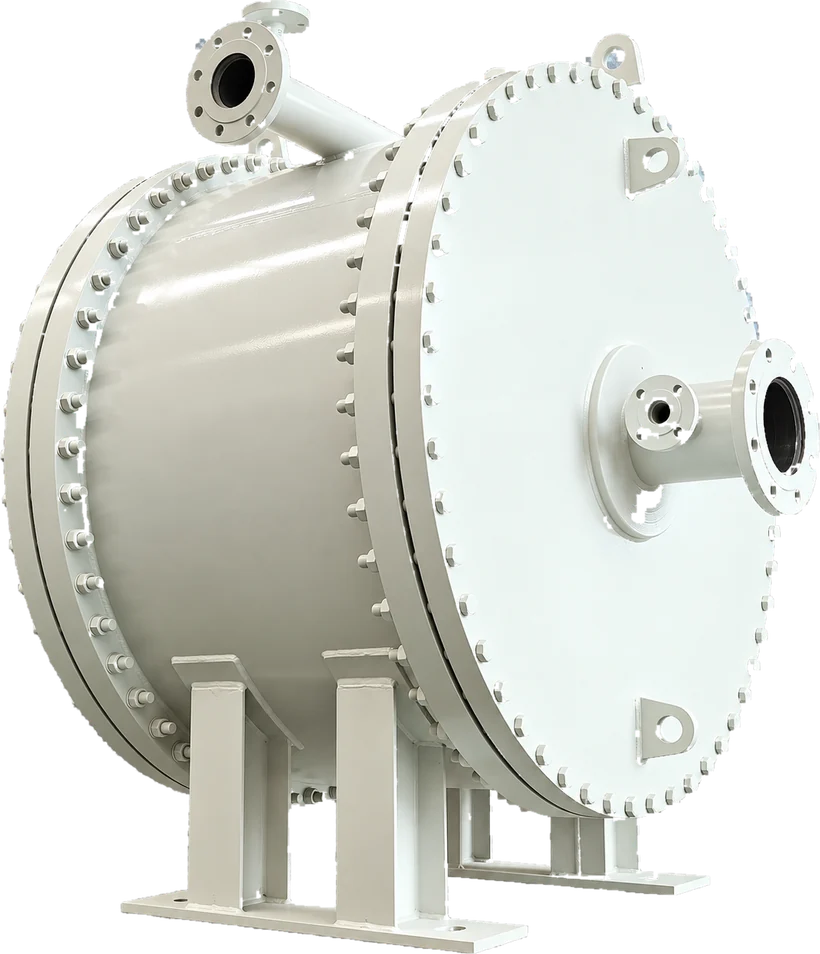
Two metal plates are wound around a central core to form a single continuous passage for each stream. There are no parallel channels for solids to settle in and no dead zones, which is why the spiral remains the practical choice for viscous liquids, sludges, slurries, and fluids carrying fibres or particles.
ARES PHE builds spiral heat exchangers in removable-cover and fully welded configurations, for heating, cooling, and heat recovery duties across wastewater, chemical, fermentation, and pulp and paper processes.
Why Choose a Spiral
Recover Useful Heat
Counter-current flow supports close temperature approaches and the reuse of heat from one process stream in another.
Handle Challenging Fluids
Channel geometry is selected around viscosity, solids content, and the available pressure drop.
Reduce Deposit Build-Up
The curved flow path promotes mixing. At maintained flow, local narrowing can increase velocity and help dislodge deposits.
Plan for Maintenance
Choose removable covers for direct channel access, or welded construction where the process duty calls for it.
How the Spiral Works
Heat passes through the plate wall as the hot and cold streams travel in opposite directions along their own continuous channels.
Conceptual flow paths. Connection positions vary by design.
Two separate circuits
The hot and cold streams remain separated by the metal plate wall during normal operation. Heat is transferred through the wall.
A continuous flow path
The curved passages promote mixing. Solids keep moving along a single channel instead of settling in parallel passages.
Heat recovery in practice
A cold outlet temperature can exceed the hot outlet temperature when the duty and flow balance permit. The cold outlet still remains below the hot inlet temperature in a passive exchanger.
Two Configurations
The channel edges are closed in one of two ways, and that single choice decides how the unit is cleaned, how it is installed, and how far the temperature envelope extends.
Removable-Cover Spiral
Direct channel access for fouling dutiesEach channel is welded closed on one edge and sealed by a cover and gasket on the open side. Removing the covers gives access for inspection and mechanical cleaning.
Full vacuum capability. Horizontal installation is generally preferred for solids-bearing duties, with sufficient clearance for cover removal and cleaning equipment.
Suited to: liquid-to-liquid duties involving fouling media, slurries, and suspended solids.
Fully Welded Spiral
Extended temperature envelopeBoth edges of the spiral channels are welded closed. The two streams follow separate spiral passages in a counter-current arrangement.
Full vacuum capability. Vertical installation is generally used to support drainage; horizontal arrangements require a specific drainage assessment and may need a tilting frame.
Suited to: liquid-to-liquid and gas-to-liquid heat transfer, including selected heating and condensation duties.
Where Spirals Are Used
Stable heat for sludge digestion
An external spiral heater transfers heat from a hot-water circuit into sludge without diluting the process stream. A dedicated passage is sized around the actual sludge, its fibres, grit, and variable solids content.
Cooling for demanding liquids
Viscous liquids, suspensions, and selected slurries need more than a nominal heat-transfer area. Gap and velocity are selected for viscosity and solids, balancing heat transfer against pressure drop and erosion.
Controlled heat in fermentation
An external spiral cooler removes heat from fermentation broths as process conditions change, balancing temperature control against broth viscosity, product sensitivity, and validated cleaning.
Heat recovery from mill water
Warm white water and selected mill effluents provide useful heat for incoming process water. The duty is designed around fibres, contaminants, and a real demand for the recovered energy.
Choosing Between the Two
| Selection point | Removable cover | Fully welded |
|---|---|---|
| Typical duties | Liquid-to-liquid exchange with fouling or solids-bearing media | Liquid-to-liquid and selected gas-to-liquid duties |
| Channel edge closure | Welded on one edge; cover and gasket on the open side | Welded on both edges |
| Channel cleaning | Direct inspection and mechanical access after cover removal | Flushing or compatible chemical cleaning; access depends on design |
| Usual orientation | Horizontal for solids-bearing service | Vertical for drainage; assess horizontal arrangements individually |
| Selection priority | Access for maintenance and gasket suitability | Temperature envelope, materials, and drainage |
The temperature and pressure ranges above describe the available design envelope. Maximum values are not necessarily available in the same unit. Plate material, thickness, seals, and the differential pressure between circuits must be assessed together.
Tell Us About Your Process
Send your operating conditions to ARES PHE. The following information helps define the thermal duty, channel geometry, materials, and installation requirements.
Process fluids
Fluid names, composition, and concentrations on both sides.
Thermal duty
Flow rates, inlet and required outlet temperatures, or heat load.
Pressure conditions
Operating and design pressures, allowable pressure drop, and vacuum requirements.
Fluid properties
Viscosity, density, solids loading, particle size, and fouling tendency.
Mechanical details
Preferred materials, installation space, and connection details.
Cleaning method
Planned cleaning chemistry and access requirements, which influence the configuration choice.
Discuss a Spiral Duty
Send us your operating conditions and our engineering team will review the duty and develop the equipment specification.