
Key takeaways
- A gasketed plate heat exchanger suits most liquid duties and can be opened, cleaned and extended later.
- The fluids decide the materials: water chemistry and temperature set the plate grade, and the gasket sets the practical limits of the unit.
- Welded and shell and plate designs take over where temperature, pressure or chemistry go beyond gasket limits.
- Correct sizing matters more than a large safety margin. An oversized unit can foul faster.
- A complete enquiry with flows, temperatures and pressure drop gets you an accurate selection the first time.
What is a plate heat exchanger?
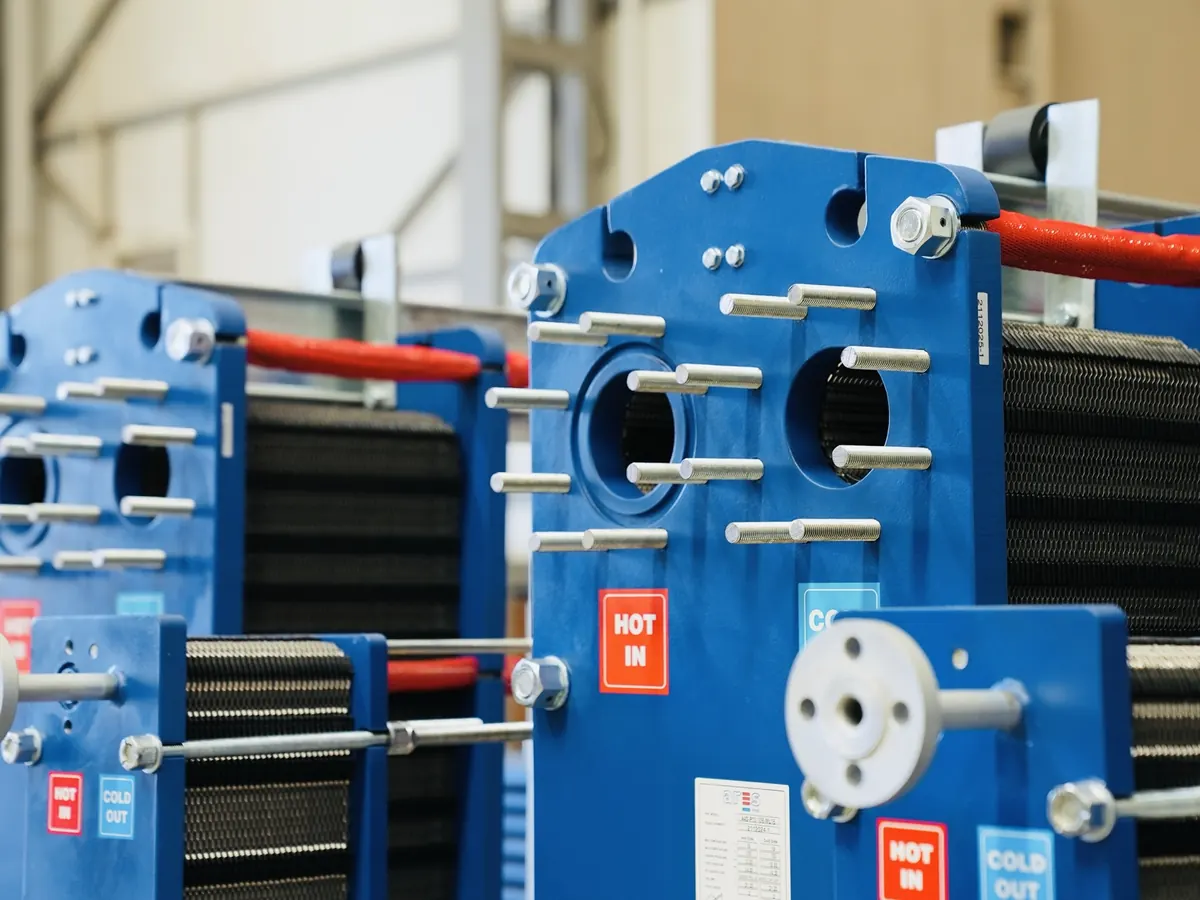
A plate heat exchanger transfers heat between two fluids without letting them mix. It is a pack of thin corrugated metal plates clamped in a frame. Gaskets seal the plates and send the hot and cold fluids through alternate channels, flowing in opposite directions.
The corrugations make the flow turbulent, which is what moves heat so effectively. The frame can be opened for inspection and cleaning, and on a gasketed unit plates can be added later if you need more capacity.
This guide explains how to choose a plate heat exchanger step by step, and what ARES PHE needs from you to prepare a quotation.
What are the benefits of a plate heat exchanger?
Lower energy cost
Typically two to three times more heat transferred per square metre than a shell-and-tube unit in liquid-to-liquid duties.
More heat recovered
True counter-flow lets one outlet come within about 1 °C (about 2 °F) of the other inlet. Pasteurisation duties achieve recovery above 90%.
Less floor space
The same duty fits in a far smaller footprint, with no space needed to pull tubes.
Room to grow
Capacity on a gasketed unit can be changed by adding or removing plates.
Simple maintenance
The unit opens for access to every plate, or it can be cleaned in place without opening.
Affordable corrosion resistance
Thin plates use little metal, so stainless steel, titanium and higher alloys stay economical.
A tubular exchanger can still be the better choice for large gas flows, vapours with very low allowable pressure drop, or conditions beyond gasket limits.
Where are plate heat exchangers used?
The right choice starts with the duty. These are the most common ones, with what matters to the buyer in each.
HVAC and district energy
District heating substations, chiller and cooling-tower isolation, pressure breakers in tall buildings and domestic hot water. A close temperature approach is the value here, and the ARES PHE AP-Series plates are designed for it.
Data centre cooling
The exchanger separates the facility water from the IT cooling loop and makes free cooling possible for more hours of the year. Gasketed units such as the ARES PHE A-Series suit this duty, because they can be opened for inspection and extended as the load grows.
Marine and sea-water cooling
Central cooling against sea water, jacket-water cooling and lube-oil cooling. Sea water requires titanium Gr. 1 plates.
Food, dairy and beverage
Pasteurisation with heat recovery, milk and juice cooling, wort cooling and heating of cleaning solutions. Hygienic plate designs with food-contact gaskets, cleaned in place, are the usual answer.
Fluids with fibres or solids
Sugar juice, ethanol mash, pulp and paper streams and waste water. ARES PHE AWG free-flow plates have a 5 to 12 mm (0.2 to 0.5 in) gap with no contact points between plates, so fibres and particles pass through.
High-temperature and high-pressure process duties
Oil and gas, petrochemical and chemical duties often go beyond what gaskets can handle, and welded designs take over. The ARES PHE AWB welded block, for example, is built for up to 60 bar (870 psi) and 400 °C (752 °F), with cleaning access on four sides.
Not sure which design fits your duty?Send your operating data to ARES PHE engineering and we will recommend a type and size.
Contact our engineersHow to choose a plate heat exchanger in three steps
Choose the exchanger type
Start with the gasketed design and move away from it only when the duty requires. It is the most flexible and the easiest to service.
| Type | Best for | Keep in mind |
|---|---|---|
| Gasketed | Most liquid duties in HVAC, food, marine and industry | Limited by gasket temperature, pressure and chemical resistance |
| Gasketed free-flow | Fluids with fibres, particles or high viscosity | Larger unit for the same duty |
| Double-wall | Duties where the two fluids must never mix | Slightly lower efficiency |
| Semi-welded | Refrigerants such as ammonia; an aggressive fluid on one side | One side is still gasketed |
| Brazed | Compact heating and refrigeration duties with clean fluids | Cannot be opened or extended |
| Welded, shell and plate | High temperature, high pressure, aggressive chemicals, steam | Fixed capacity |
Choose the plate material
Plates are thin, so the material must resist the fluid completely. Water chemistry, especially the chloride content, and temperature decide the grade. This is why a supplier asks for a water analysis.
| Plate material | Typical fluids |
|---|---|
| Stainless steel 304 | Clean water and closed loops |
| Stainless steel 316 | General-purpose choice for water and process fluids |
| Titanium Gr. 1 | Sea water, brackish water and chloride-rich fluids |
| 6Mo and alloy C-276 | Chloride-rich process waters and acids (not sea water) |
Choose the gasket material
The gasket sets the practical temperature, pressure and chemical limits of a gasketed unit.
Water, oils and fuels.
Hot water, steam, glycols and cleaning chemicals. Not for oils.
Acids, hot oils and aggressive chemicals.
The limit of each depends on the compound and the fluid, so the final material and gasket selection is confirmed by ARES PHE engineering from your fluid data.
What to send for a quotation
A complete enquiry avoids rounds of questions and gives you an accurate selection the first time.
- The two fluids
- Flow rates on both sides
- Inlet and outlet temperatures
- Allowable pressure drop
- Design pressure and design temperature
- A water analysis, if chlorides or solids are present
- Any required standard or material
- Space limits and planned future capacity
Resist the urge to add a large safety margin. Too many plates slow the flow and can make fouling worse.
Why ARES PHE
ARES PHE has manufactured plate heat exchangers in Adana, Türkiye since 2002 and exports 95% of its production. Plates are pressed in-house, with a pressing capacity of up to 20,000 tons, so plate quality stays under one roof.
The product range covers every type in this guide. The A-Series handles general gasketed duties. The AP-Series is optimised for a close temperature approach. AWG free-flow plates handle fibres and solids, and ADP double-wall plates are for fluids that must never mix. Brazed, semi-welded, fully welded, welded block, shell and plate and spiral designs complete the range. You get one supplier for the whole plant instead of a different one for each duty.
ARES PHE engineers size each unit for your actual operating data. After delivery, spare plates and gaskets are identified from the serial number on the nameplate, which keeps service simple over the life of the unit.
Frequently asked questions
What information do I need to size a plate heat exchanger?
You need the two fluids, their flow rates, the inlet and outlet temperatures on both sides and the pressure drop you can allow. Design pressure and temperature, a water analysis where chlorides or solids are present, and any required standard or material complete the picture.
Which plate material should I choose?
Stainless steel 316 is the general-purpose choice for most water and process duties. Clean closed loops can often use 304. Sea water and brackish water need titanium Gr. 1 plates. Higher alloys cover chloride-rich process waters and acids. The final grade is confirmed from your fluid data.
When is a gasketed plate heat exchanger not the right choice?
When temperature, pressure or the chemistry of the fluid goes beyond what gaskets can handle. In those duties a semi-welded, fully welded, welded block or shell and plate design is typically used. For sludge and heavily fouling fluids, a spiral heat exchanger is often the better fit.
Can I increase the capacity of a plate heat exchanger later?
Yes, with a gasketed unit. Plates can be added to the frame to raise capacity, as long as the frame was specified with room to grow. Tell your supplier about planned future capacity at the enquiry stage so the frame length and connections are chosen to suit.
Is a bigger plate heat exchanger a safer choice?
Not usually. Too many plates slow the flow through each channel, and slow flow lets deposits settle, which can make fouling worse. A unit sized correctly for the real duty typically stays cleaner and performs better than one with a large safety margin.