
Sugar & Ethanol
Sugar and ethanol production requires reliable, efficient and easy-to-maintain heat transfer equipment across many process stages, from raw juice heating and syrup concentration to fermentation cooling, distillation condensers and utility heat recovery. ARES PHE supplies gasketed and Free Flow / Wide Gap plate heat exchangers engineered for the realities of cane sugar mills, beet sugar processors, and the ethanol distilleries built around them.
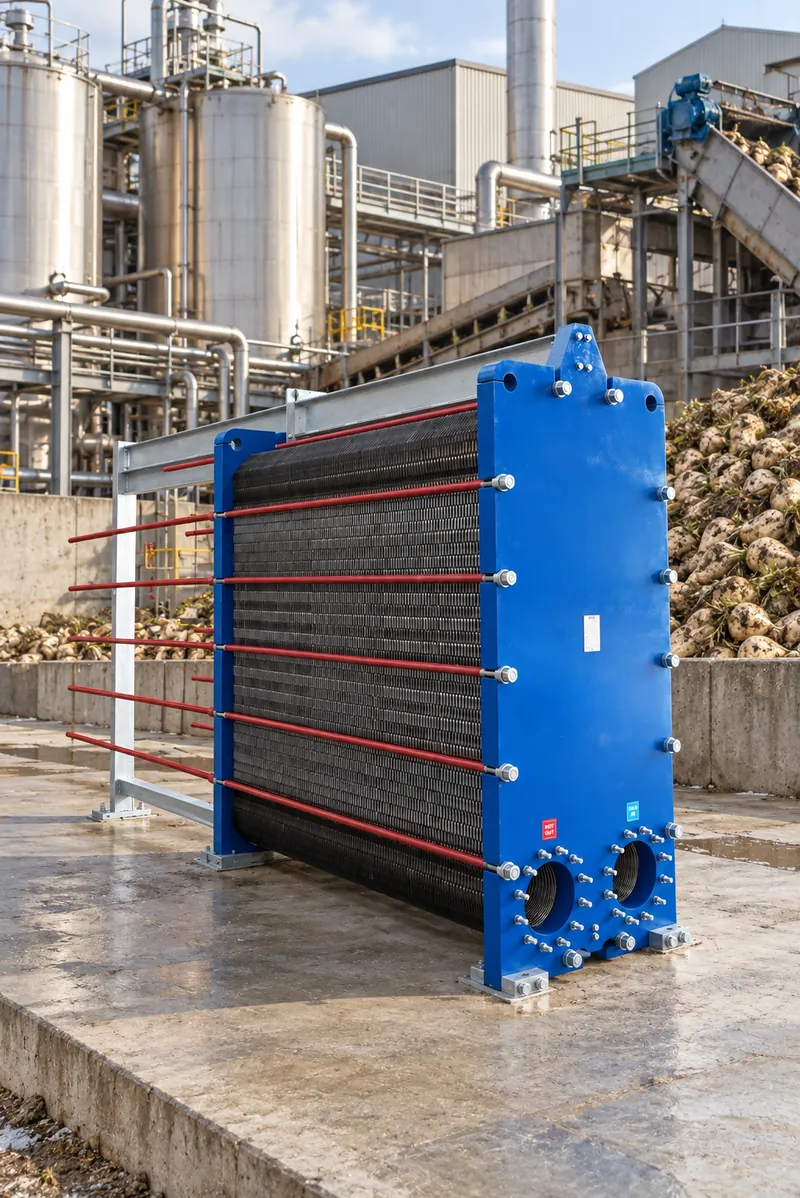
Engineered for Sugar Mills, Refineries, Distilleries and Ethanol Plants
ARES PHE provides gasketed and Free Flow / Wide Gap plate heat exchangers designed for demanding sugar and ethanol applications where thermal efficiency, reduced fouling tendency, compact footprint and operational flexibility are critical. Wide-gap plate heat exchangers are especially suitable for media containing fibres, suspended solids, or higher viscosity, including raw juice, limed juice, mixed juice, molasses and mash streams, in line with established PHE practice in cane and beet sugar mills.
Sugar and ethanol industries are deeply interconnected. In cane-producing regions, sugar mills and ethanol distilleries typically share a single integrated site, molasses from sugar production becomes feedstock for fermentation. In Europe, North America, and Türkiye, beet sugar plants and grain ethanol distilleries (wheat, corn) often operate independently but share many of the same thermal processes. The same ARES PHE product families serve both industries throughout the production cycle.
Typical Applications in Sugar and Ethanol
From the front end of the plant (juice extraction or mash preparation) through clarification, evaporation, fermentation, and distillation, plate heat exchangers handle the heat transfer at every stage. Many duties appear in both sugar mills and ethanol distilleries; some are specific to one industry. The applications below cover the full range across cane sugar, beet sugar, and ethanol from sugar, wheat and corn feedstocks.
Raw Juice and Mash Heating, Front-End Duty Across Sugar and Ethanol
At the front of every sugar or ethanol plant, the primary feedstock has to be heated for the next process step. Cane mills heat raw juice before liming and clarification. Beet plants heat diffusion juice before carbonation. Grain ethanol distilleries (wheat, corn) heat mash for cooking and saccharification. Integrated cane-ethanol facilities combine cane juice heating with ethanol production; all of these duties handle fibrous, particle-bearing streams at large volume and continuous operation.
Wide-gap plate geometry handles these streams by providing larger free-flow channels with reduced clogging risk compared with narrow-channel designs. ARES PHE's AWG Free Flow plate family is engineered specifically for fibrous and particle-containing media common in sugar and ethanol front-end operations. Standard A-Series gasketed plates take over once the streams have been clarified.
Beet Diffusion & Pulp Handling
Sugar beet processors extract sucrose through hot-water diffusion of sliced beet. Plate heat exchangers heat the diffusion water and cool spent pulp pressing water for water recovery in the plant.
This duty is specific to beet sugar, not cane, but shares the same plate technology and supply chain as juice heating found elsewhere in the plant.
Clarification, Limed and Carbonated Juice Heating
After raw juice has been treated with lime (cane process) or CO₂ saturation (beet process), the clarified juice is heated again before entering the evaporator station. The chemistry is gentler than upstream raw juice, but the volume is just as high.
Standard A-Series gasketed units handle the clarified juice duty; quick-opening frames enable inspection during seasonal maintenance windows.
Evaporation & Vapour Condensers
Multi-effect evaporators appear in both sugar mills (concentrating clarified juice into syrup) and grain ethanol distilleries (concentrating stillage and process syrups). Vapour condensers between effects, condensate heat recovery, and final-stage cooling all use plate heat exchangers.
Compact AP-Series with high effectiveness handles condenser duty in less space than shell-and-tube equivalents, particularly valuable when retrofitting existing evaporator stations.
Syrup, Molasses & Refinery Heating
Thin syrup heating, clear syrup heating, and refinery operations (affination, melting, decolourisation, final crystallisation) all use plate heat exchangers throughout the train. Molasses heating and final molasses cooling before storage round out the duties.
Where the sugar will be food-grade, AFP-Series food-grade construction with FDA-compliant gaskets is used.
Fermentation Cooling, Distillery Operations
Yeast fermentation generates substantial heat that must be removed continuously to maintain optimal fermentation conditions. The duty is essentially identical across feedstocks: sugar-cane molasses, beet molasses, sugar juice, wheat mash, or corn mash.
PHEs cool the fermenter recirculation loop, with FDA-compliant food-grade gaskets where food-grade ethanol is the end product.
Distillation, Reboilers, Condensers, Reflux
Beer columns, rectifiers, and finishing columns in ethanol production use plate heat exchangers as overhead condensers, reflux condensers, and reboilers throughout the distillation train. The duty is the same whether the ethanol originates from cane molasses, beet, wheat, or corn.
Plate-and-frame technology replaces shell-and-tube in distillation duty at a fraction of the footprint, with full inspection access during planned shutdowns.
Stillage / Vinasse Cooling & Heat Recovery
The bottoms from distillation columns, vinasse in cane-based operations, stillage in grain-based operations, leave the column hot and need to be cooled before storage, evaporation for concentration, biogas production, or land application. Heat recovery from stillage to process water preheating is a primary energy-efficiency lever.
High particulate load makes free-flow plate geometry essential. AWG plates with wide channel gaps handle the duty without blockage.
CIP, Hot Water & Utility Duties
Both sugar plants and ethanol distilleries run substantial steam, hot water, and CIP utility systems. CIP heating, hot water generation, condensate recovery, and cooling tower side cooling water all use plate heat exchangers at the utility interface throughout the facility.
Standard A-Series with EPDM gaskets covers the bulk of these utility duties across both industries.
Why Plate Heat Exchangers Are Ideal for Sugar and Ethanol Plants
High Thermal Efficiency
Close approach temperatures and high heat recovery, reducing steam consumption and improving process efficiency
Compact Installation
Significantly less installation space than tubular equipment, ideal for new plants and retrofits
Lower Fouling Tendency
Free Flow / Wide Gap geometry maintains stable flow with fibrous, particulate, and viscous streams
Easy Maintenance
Gasketed units open for inspection, cleaning and re-gasketing during seasonal shutdowns
Flexible Capacity
Heat transfer area adjusts by adding or removing plates, adapts to process changes and capacity expansion
Recommended Products for Sugar & Ethanol
A-Series (Gasketed)
Clarified juice, syrup, fermentation cooling, condensate recovery, utilities
AWG Free Flow
Wide-gap design for raw juice, mash, molasses, vinasse, fibrous and particle-bearing streams
AP-Series (Performance)
Evaporator condensers, distillation overhead and reflux condensers, tight-ΔT duties
AFP-Series (Food Grade)
Food-grade sugar refining and food-grade ethanol production with FDA-compliant food-grade gaskets
Case Studies
Real projects, real results. See how ARES PHE plate heat exchangers perform in Sugar & Ethanol installations worldwide.
Sugar & Ethanol Case Study
Project overview, engineering approach, and measured results from a real installation.
Read Case Study →Engineer Your Sugar or Ethanol Plant PHE With Us
Whether your plant processes sugar, ethanol, or both, and whether the feedstock is cane, beet, wheat, or corn, our application engineers help you specify the right PHE for every duty across milling, diffusion, clarification, evaporation, fermentation, distillation, and refining.