
Steel Industry
Steel production is among the most demanding environments for industrial heat exchangers. From ironmaking through continuous casting, rolling, and surface treatment, plate heat exchangers serve every stage of the steel value chain. They keep cooling water flowing to furnaces and casters, recover waste heat from off-gases, and protecting expensive plant equipment from thermal stress.
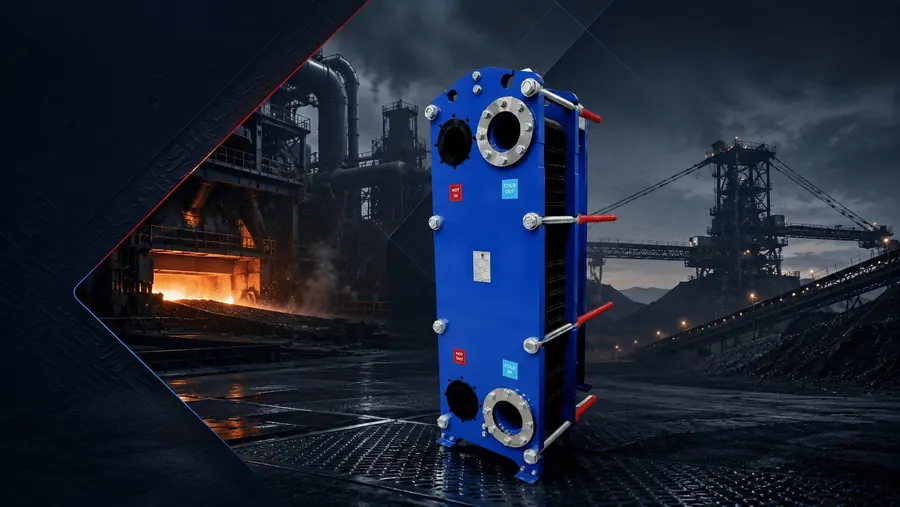
Compact, Code-Stamped, Built for Integrated Mills
ARES PHE supplies gasketed, free-flow, fully welded, and shell & plate units engineered for the realities of integrated steel mills and EAF mini-mills alike: hot dirty cooling water, aggressive pickling acids, continuous 24/7 operation, and absolute reliability. Every selection is sized for the central commercial priority: outage windows are scheduled in hours, not days.
Plate-pack design, materials, and gasket selection are matched per duty, AISI 316L plates with EPDM-peroxide gaskets for mainstream cooling water, SMO 254 or Hastelloy C276 for pickling acid, free-flow AWG geometry for descale and caster spray water, ADP double-plate for oil-contaminated cooling water with vented intermediate space.
Where PHEs Work in Steel Mills
From the blast furnace stove to the cold mill emulsion cooler, plate heat exchangers handle thermal duties across every stage of integrated steel production and EAF mini-mill operations.
Continuous Caster Mould Cooling, Quality-Critical
The continuous caster mould is where liquid steel becomes solid strand. Mould water temperature must be held within a tight band, too cold and solidification is uneven, leading to internal cracks; too hot and the mould wall overheats, leading to break-outs that shut down the caster. The PHE sits between the closed mould water loop and the open cooling water system, transferring heat while keeping the high-purity mould water completely isolated.
Plate material is AISI 316L or higher; gasket selection accounts for the trace chemistry of treated mould water. Quick-opening frames allow mould water plate-pack inspection during routine caster outages, typical full inspection and re-gasket completes within an 8-hour shift.
Blast Furnace Stave Cooling
Blast furnace cooling staves handle massive heat fluxes from the reaction zone. The closed soft-water loop circulates through hundreds of staves and rejects heat through PHEs to the open cooling water system.
Any failure of the cooling system can cause blast furnace damage within minutes. PHE redundancy, quick-opening frames for inspection, and reliable spare parts availability are non-negotiable.
Blast Furnace Stove Off-Gas Heat Recovery
Hot blast generation in Cowper stoves consumes large amounts of fuel gas. Recovering heat from the off-gas to pre-heat combustion air dramatically improves stove thermal efficiency, a major decarbonisation lever for integrated mills.
AFW fully welded units handle the high-temperature off-gas without gasket-compatibility concerns.
EAF Closed-Loop Cooling Water
Electric arc furnace transformers, delta closures, bus tubes, and electrode holders all need high-purity closed-loop cooling water. The PHE rejects this heat to the open cooling tower system while keeping the EAF side ultra-clean.
Verified thermal performance ensures the calculated heat balance matches operational reality.
Hot Rolling Mill Descale Water
Hot mill descale water carries enormous amounts of oxide scale and particulate. Conventional plate geometry would clog within days. AWG free-flow plates with 5.5+ mm channel gaps allow particulates to pass through unobstructed.
Free-flow plates also tolerate the high fluid velocities required for effective descale operation.
Pickling Acid Heating
HCl or H₂SO₄ pickling baths must be heated to optimal pickling temperature. Plate material selection drives cost and service life: SMO 254 for moderate H₂SO₄, Hastelloy C276 for HCl. FKM (Viton) gaskets handle the acid vapour environment.
AFW fully welded construction is preferred where gasket failure cannot be tolerated.
Cold Rolling Emulsion Cooling
Cold rolling mills use oil-in-water emulsion for lubrication and cooling. The emulsion must be temperature-controlled tightly, too hot and it breaks down, too cold and lubrication suffers.
FKM gaskets handle emulsion chemistry without softening or swelling.
Oil-Contaminated Cooling Water (Double-Wall)
Mill-bay cooling water carries an ever-present risk of oil contamination from hydraulic and lubrication systems. ADP double-plate construction with vented intermediate space gives auditors confidence that oil cannot migrate into the cooling tower circuit.
Any leak appears in the vented gap, never crossing into the other fluid.
Why PHEs Are the Steel Industry Standard
Outage-Window Service
Full plate-pack drop-out and re-gasket within an 8-hour shift
Free-Flow for Descale
AWG geometry handles oxide-scale-laden water without blockage
Double-Plate Safety
ADP units for oil-contamination-risk closed cooling water duties
Code Stamped
PED Module H, ASME Section VIII Division 1, code-compliant pressure equipment
25+ Year Service
Typical service life with planned maintenance
Recommended Products for Steel Industry
A-Series (Gasketed)
Cooling water, mould water, EAF panels, plant-wide closed loops
AWG Free Flow
Hot mill descale water, caster spray, high-particulate streams
AFW Full Welded
Pickling acid, off-gas heat recovery, decarbonisation
ADP Double Plate
Oil-contaminated cooling water with vented safety gap
Case Studies
Real projects, real results. See how ARES PHE plate heat exchangers perform in Steel Industry installations worldwide.
Steel Industry Case Study
Project overview, engineering approach, and measured results from a real installation.
Read Case Study →Specify Your Steel Mill PHE With Our Application Engineers
Steel-industry duties span the full thermal range and demand the discipline of code-stamped pressure equipment. Our application engineers help you size, configure, and document the right PHE for your mill.