
HVAC & District Energy
From a 50-storey office tower to a district energy network heating an entire neighbourhood, plate heat exchangers move the heat that modern buildings depend on. They sit between every chiller and cooling tower, every district heating substation and consumer loop, every heat pump and process. Compact, efficient, and serviceable. They are the building block of modern HVAC plant rooms.
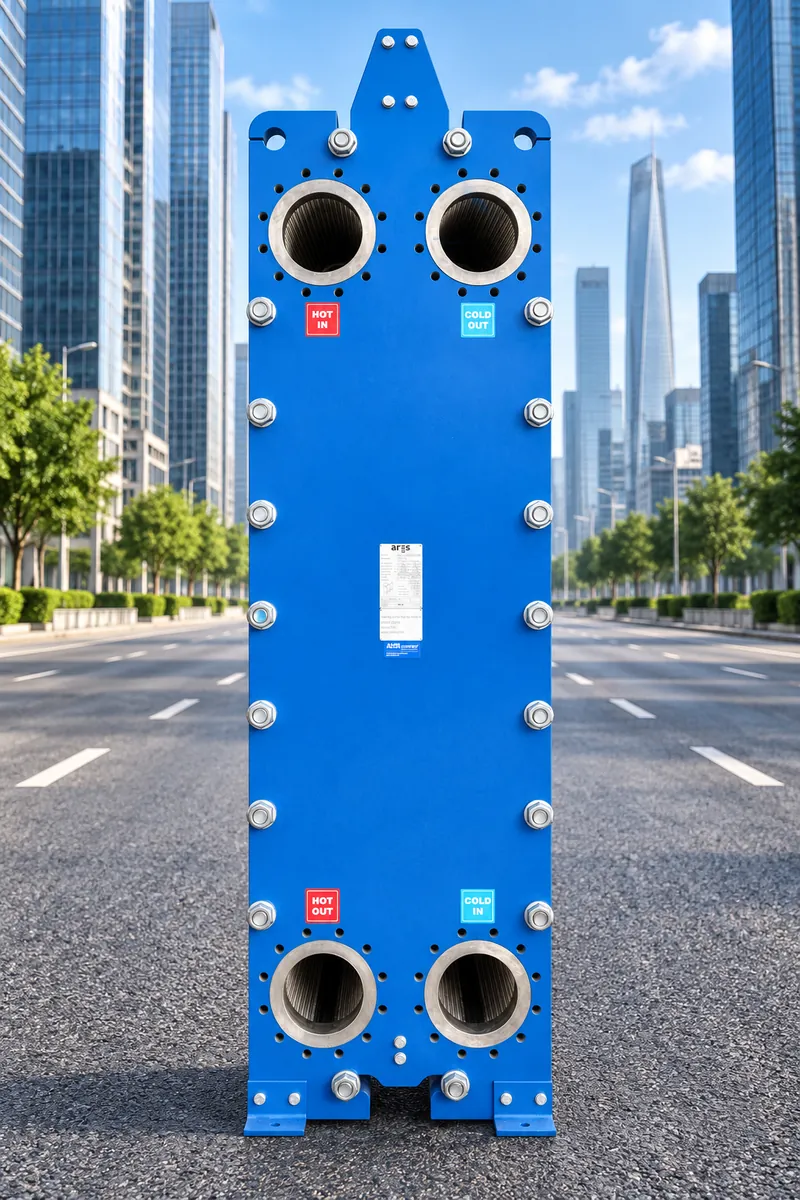
Engineered for Chillers, Heat Pumps, and District Energy
Modern HVAC plant rooms are increasingly tight on space, increasingly hot on the supply side (high-temperature heat pumps now reach 90°C+), and increasingly scrutinised on energy efficiency. ARES PHE plate heat exchangers are designed for exactly these conditions, compact enough to fit retrofits, efficient enough to support COP-critical heat pump duties, and serviceable enough to outlast the building services around them.
Our AH-Series units carry AHRI Standard 400 certified performance ratings, a globally recognised benchmark for liquid-to-liquid PHE thermal capacity, and ship with full PED, ASME, and EN-coded documentation as standard. The same product family handles chiller-side cooling, heat pump evaporators and condensers, district heating substations, and free-cooling installations.
Where PHEs Work in HVAC & District Energy
From the chiller plant in the basement to the substation feeding a residential block, plate heat exchangers handle the thermal junctions where building services meet utility networks. Below: the duty patterns we see most often across HVAC and district energy projects.
District Energy Substations, Where Networks Meet Buildings
In indirectly connected networks, each building connection is typically a plate heat exchanger. The network side carries high-temperature water (often 90–130°C) from a central plant, combined heat & power, biomass boiler, heat pump, geothermal, or waste heat, and the building side runs its own closed loop at lower temperatures for radiators, fan coils, or underfloor heating. The PHE isolates the two hydraulically while transferring heat.
Substation design is dominated by ΔT optimisation: the lower the return temperature on the network side, the more heat the network can deliver per cubic metre of water, and the more efficient the central plant becomes. ARES PHE substation units routinely achieve <1°C LMTD, returning water to the network at the lowest possible temperature for maximum network capacity.
Chiller-Side Heat Rejection
Every water-cooled chiller plant rejects condenser heat to a cooling tower, and the link between them is almost always a plate heat exchanger. The PHE isolates the closed chiller condenser loop (treated water) from the open cooling tower water (full of dissolved solids, biological matter, and corrosion inhibitors).
Without the PHE, cooling tower water would contaminate the chiller condenser, scale up the heat transfer surface, and shorten the equipment life. With it, the chiller side stays clean and the tower side does the dirty work.
Heat Pump Evaporator & Condenser
Industrial and district-scale heat pumps depend on plate heat exchangers as both evaporator (refrigerant-to-water) and condenser (refrigerant-to-water) units. High-temperature heat pumps push supply temperatures above 90°C, territory that demands plates and gaskets engineered for the duty.
ARES PHE supports natural refrigerants (CO₂, ammonia, propane) and synthetic blends, with material and gasket combinations matched to each circuit. AHRI-certified thermal performance on the water side keeps COP modelling honest.
Free Cooling, Winter Mode Without Chillers
When outdoor wet-bulb temperatures fall far enough below the chilled water supply temperature (allowing for tower and PHE approach), the chiller can be bypassed and the cooling tower can supply chilled water directly through a plate heat exchanger. This is free cooling, delivering significant energy savings in spring, autumn, and winter across data centres, large office buildings, and process cooling installations.
The free-cooling PHE is sized differently from a chiller-side unit: it operates at small ΔT, often with marginal driving temperature, and must deliver high thermal effectiveness to extract every available degree. Plate selection and pass arrangement are critical.
Pressure Breaking in High-Rise Buildings
In tall buildings, static water pressure at lower floors can exceed the working pressure of equipment installed there. A plate heat exchanger breaks the hydraulic circuit into pressure zones, typically every 10–15 floors, while still transferring heat between zones.
PHEs are ideal for this duty because they tolerate high working pressures (16–25 bar gasketed, higher with semi-welded), occupy little plant-room space per floor, and isolate the heating or chilled water circuits hydraulically.
Domestic Hot Water Generation
Centralised domestic hot water systems in hotels, hospitals, residential complexes, and offices use plate heat exchangers to generate DHW from primary heating water, instantaneously, on demand, with minimal stored volume. This greatly reduces the legionella risk associated with large hot water storage tanks.
ARES PHE supplies instantaneous DHW packages, and stainless steel construction throughout the wetted side for hygiene and longevity.
Building Heating Distribution
Once heat enters a building from its primary source (district network, on-site boiler, or heat pump), it needs to be distributed to radiators, fan coils, AHUs, and underfloor circuits, often at different temperatures for each loop. Plate heat exchangers split the building-side hydraulics into separate temperature regimes while preserving the primary loop integrity.
Multi-loop building services often run 3–5 PHEs in parallel from a single primary header, each feeding a different distribution circuit.
Why PHEs Are the HVAC Industry Standard
60% Smaller
Critical in plant rooms where every cubic metre is rented at premium rates
AHRI Certified
AH-Series performance certified to AHRI Standard 400, a globally recognised benchmark
<1°C LMTD
Extracts every available degree, maximising free cooling and network ΔT
Heat Pump Ready
High-temperature heat pump duties up to 120°C with the right plate selection
Field Serviceable
Inspect, clean, and re-gasket on-site without specialist tools or extended downtime
Recommended Products for HVAC & District Energy
A-Series (Gasketed)
Workhorse for chiller-side cooling, building distribution, and DHW
AP-Series (Performance)
High-efficiency plate pattern for close-approach duties
AH-Series (AHRI Certified)
AHRI Standard 400 certified performance for HVAC and district energy duties
AWG Free Flow
For free-cooling and water with elevated particulate load
Case Studies
Real projects, real results. See how ARES PHE plate heat exchangers perform in HVAC & District Energy installations worldwide.
HVAC & District Energy Case Study
Project overview, engineering approach, and measured results from a real installation.
Read Case Study →Ready to Specify Your HVAC Heat Exchanger?
Our HVAC application engineers work directly with your team (chiller plant designers, district energy planners, building services consultants) to size, configure, and certify the right PHE for your project.