
Food & Dairy
Milk pasteurisation, juice concentration, beer wort cooling, brine chilling, edible-oil refining: the food and dairy industry depends on plate heat exchangers for the most fundamental thermal operations of food production. Hygienic design, FDA-compliant materials, CIP-able geometry, and verified thermal performance: every detail engineered to food and beverage industry standards.
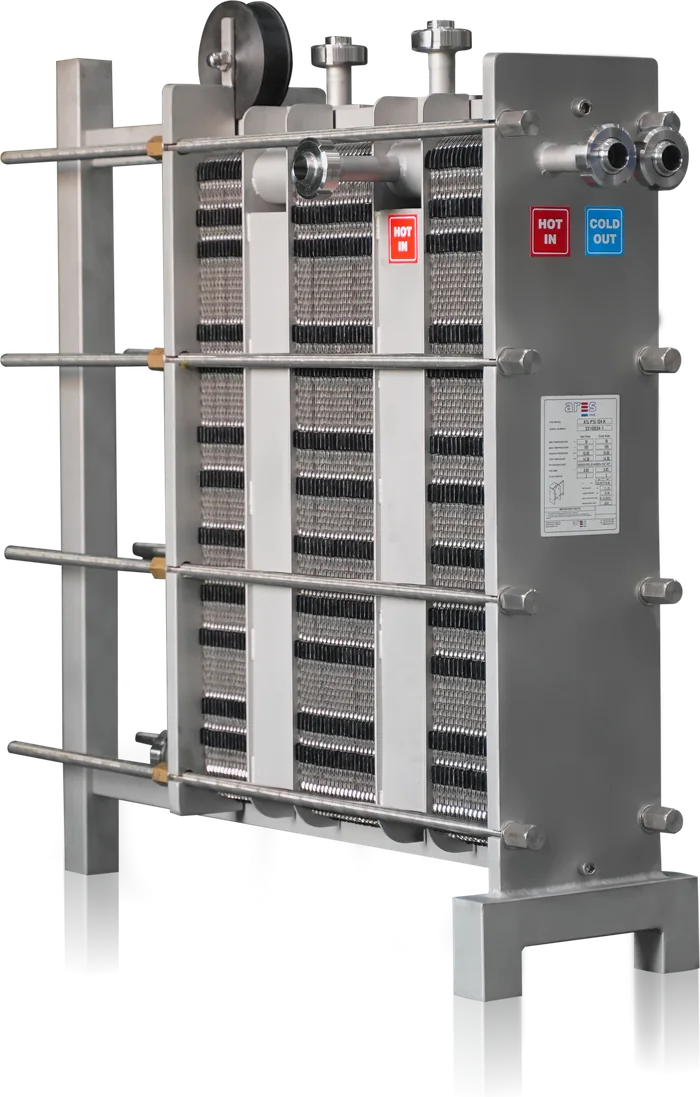
Hygienic Design for Food, Dairy, and Beverage
ARES PHE supplies plate heat exchangers compliant with the rigorous standards of food and dairy processing: FDA-compliant food-grade gasket materials (EPDM-P, NBR), EU regulation 1935/2004 compliance for food contact, EHEDG hygienic design principles, and CIP-cleanable geometry that maintains thermal performance through years of daily sanitation cycles.
The AFP-Series, our food-grade plate heat exchanger family, features specifically designed plate patterns, gasket grooves, and surface finish for hygienic processing, with FDA-compliant food-grade gaskets. Standard A-Series with FDA gaskets handles ancillary food-industry utilities; AFP-Series handles the product-side duties where hygienic certification is critical.
Where PHEs Work in Food & Dairy Processing
From the raw milk receiving station to the finished product packaging line, plate heat exchangers handle thermal duties across pasteurisation, concentration, sterilisation, and ancillary utilities throughout the food and beverage industry.
HTST Pasteurisation, The Industry Workhorse
High-temperature short-time (HTST) pasteurisation is the standard milk-processing operation: raw milk is heated to 72°C, held for 15 seconds, then cooled back to 4°C for storage. The PHE achieves all three sections, heating, regeneration, and cooling, in a single multi-section unit with intermediate temperature monitoring and flow diversion.
AFP-Series pasteurisers feature FDA-compliant food-grade EPDM-P gaskets, hygienic plate patterns, full-port flow distribution, and 316L plate construction. Regeneration efficiency typically exceeds 92%, recovering most of the heating energy.
UHT Sterilisation
Ultra-high-temperature (UHT) processing heats product to 135-150°C for a few seconds to achieve commercial sterility. The PHE handles the rapid heating and cooling, with steam-side heating and chilled-water cooling sections.
Higher temperatures require specific plate and gasket selection.
Beverage Cooling & Carbonation
Brewery wort cooling, soft drink syrup cooling, beverage CO₂ saturation, all use plate heat exchangers for their compact size, hygienic design, and CIP-ability.
Standard A-Series with FDA gaskets handles these duties.
Whey & Juice Concentration
Evaporator pre-heaters and condensers in whey concentration and juice processing use PHEs throughout. The PHE handles the temperature transitions between evaporator stages and the final product cooling.
Verified thermal performance ensures the production rate matches the design.
Edible Oil Cooling
Refined edible oils need cooling from process temperatures down to storage temperatures. The PHE handles the bulk cooling duty; FKM gaskets handle the oil chemistry.
Vegetable oils, fish oils, and rendered fats all use similar PHE configurations.
CIP & Sanitation Systems
Clean-in-place (CIP) systems heat caustic and acid solutions to ~80°C for cleaning the process lines. PHEs heat the CIP solutions from utility steam or hot water.
Plates and gaskets selected for caustic and acid compatibility at CIP temperatures.
Cooling Tower Side Utilities
Food and dairy plants use chilled water and cooling water utilities throughout, for ammonia condensers, glycol chilling, freezer rooms, and product chilling. PHEs handle the interface between closed treated cooling water and open cooling tower water.
Standard A-Series with EPDM gaskets handles the non-food-contact duty.
Why PHEs Are Standard in Food & Dairy
FDA Gaskets
EPDM-P and NBR food-grade compounds, FDA-compliant for direct food contact
EHEDG Design
Hygienic design principles for plate patterns and flow distribution
CIP Cleanable
Clean-in-place capability with caustic and acid CIP solutions
EU 1935/2004
Food contact materials compliant with European food safety regulation
Regen Efficiency
Pasteuriser regeneration sections typically exceed 92% heat recovery
Recommended Products for Food & Dairy
AFP-Series (Food Grade)
Pasteurisers, UHT, hygienic product-contact duties
A-Series (Gasketed)
Beverage cooling, CIP heating, utility duties
AP-Series (Performance)
Tight-ΔT duties, evaporator auxiliaries
Case Studies
Real projects, real results. See how ARES PHE plate heat exchangers perform in Food & Dairy installations worldwide.
Food & Dairy Case Study
Project overview, engineering approach, and measured results from a real installation.
Read Case Study →Engineer Your Food Process PHE With Us
From farm to packaging, our food and dairy application engineers help you specify hygienic, FDA-compliant, CIP-cleanable plate heat exchangers matched to your production line and product specifications.