
Chemical & Petrochemical
Chemical and petrochemical processes demand heat exchange across a vast range of chemistries, pressures, and temperatures. Aggressive acids, caustics, solvents, hot polymerisation reactions, distillation duties, and corrosive process water: every duty drives different material, gasket, and construction choices. ARES PHE supplies the full range from gasketed to fully welded to shell-and-plate, with the materials and code documentation chemical plants require.
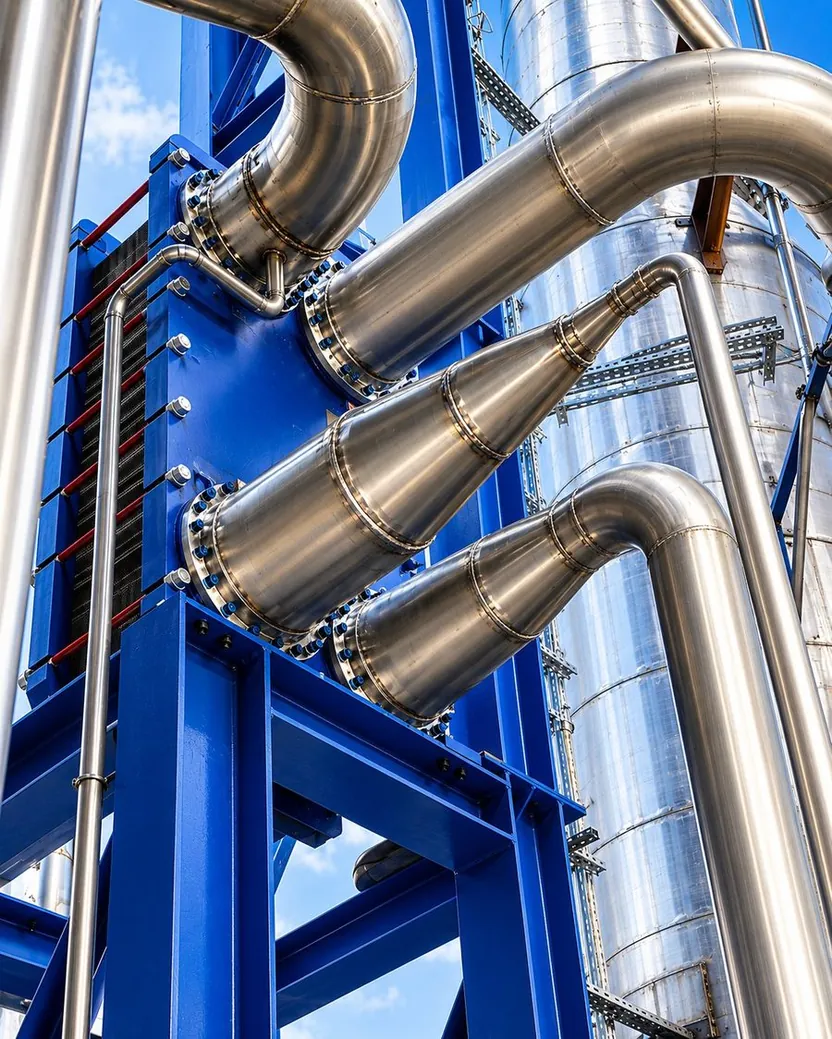
Engineered for Aggressive Chemistry and Code Compliance
Chemical and petrochemical PHE specification balances chemistry, fouling tendency, pressure rating, code requirements, and the operational reality of continuous process plants where outages are scheduled in days, not hours. Plate material drives the cost equation: 316L for moderate duties, Hastelloy C276 for HCl service, titanium or Inconel 625 for chloride-bearing chemistry, and nickel alloys for caustic services.
Where gasket compatibility with aggressive chemistry cannot be guaranteed, AFW fully welded plate-pack construction eliminates the gasket exposure entirely. ASP shell-and-plate units handle the highest pressure-and-temperature combinations.
Where PHEs Work in Chemical & Petrochemical
From the reactor jacket to the distillation column reflux condenser, plate heat exchangers handle heat-transfer duties across every unit operation in chemical and petrochemical processing.
Reactor Jacket Cooling & Heating
Batch and continuous reactors require precise temperature control of their contents, exothermic reactions need cooling to prevent runaway, endothermic reactions need heating to maintain conversion. The reactor jacket carries thermal fluid (cooling water, brine, glycol, hot oil, or steam) and the PHE handles the interface between the jacket loop and the utility-side heat source or sink.
Tight ΔT control on the jacket loop is critical for product quality. AP-Series Performance plate patterns deliver the effectiveness needed; high-alloy plates handle the aggressive reactor side chemistries.
Distillation Column Heat Recovery
Distillation columns are the energy-intensive heart of most chemical plants. Heat integration between feed pre-heat and bottoms cooling, between rectification and stripping sections, and between adjacent distillation systems all use PHEs to recover thermal energy.
AFW welded units handle the more aggressive chemistries on the column side.
Acid & Caustic Services
Sulphuric acid, hydrochloric acid, nitric acid, sodium hydroxide: chemical plants handle aggressive acid and caustic services across many unit operations. Plate material selection (Hastelloy C276, titanium, nickel alloys) determines service life.
AFW fully welded construction eliminates gasket exposure where aggressive chemistry would degrade conventional elastomers.
Polymerisation Cooling
Polymer reactors generate substantial heat of reaction. Reactor cooling via a recirculating loop through external PHEs is standard for many polymer chemistries (PVC, polystyrene, polyolefins).
Plate selection accounts for the high viscosity of polymer-bearing streams and the fouling tendency of monomer and oligomer residues.
Solvent Recovery
Solvent recovery operations (toluene, methanol, ethanol, hexane) use distillation columns with PHE-based reflux condensers, overhead coolers, and feed pre-heaters. Recovery economics depend on heat integration.
FKM gaskets handle most organic solvent chemistries.
Cooling Tower Side Cooling
Chemical plant cooling water systems use PHEs at every interface between closed treated cooling water and open cooling tower water. The closed side is protected from biofouling and corrosion by isolation.
Standard A-Series and AP-Series units with verified thermal performance handle the bulk of the duty.
Vacuum & Condenser Duties
Vacuum systems, steam ejector condensers, and vapour recovery condensers throughout chemical plants use plate heat exchangers for their compact size and inspectability.
Plate-and-frame technology replaces shell-and-tube in many condenser duties at reduced footprint.
Why PHEs Are Standard in Chemical Processing
Alloy Materials
Hastelloy, titanium, nickel alloys for the most aggressive chemistries
Welded Construction
AFW units eliminate gasket exposure where chemistry would fail elastomers
Code Stamped
PED Module H, ASME Section VIII Division 1, AD 2000 Merkblatt
ATEX Compliant
Zone 1 and Zone 2 frame components for flammable atmospheres
Compact Retrofit
40-60% smaller than equivalent shell-and-tube for retrofit installations
Recommended Products for Chemical & Petrochemical
A-Series (Gasketed)
Cooling water, solvent recovery, polymer cooling
AFW Full Welded
Aggressive acids, caustics, solvents, no gasket exposure
AP-Series (Performance)
Reactor jacket cooling, tight-ΔT distillation duties
Case Studies
Real projects, real results. See how ARES PHE plate heat exchangers perform in Chemical & Petrochemical installations worldwide.
Chemical & Petrochemical Case Study
Project overview, engineering approach, and measured results from a real installation.
Read Case Study →Engineer Your Chemical Plant PHE With Us
Chemical-process duties demand careful materials selection, gasket-or-welded judgment, and full code documentation. Our application engineers help you specify the right PHE for your duty.